In the push for operational excellence, mid-market executives face a compounding challenge: scaling transaction volume and data across fragmented ecosystems without letting overhead collapse their margins.
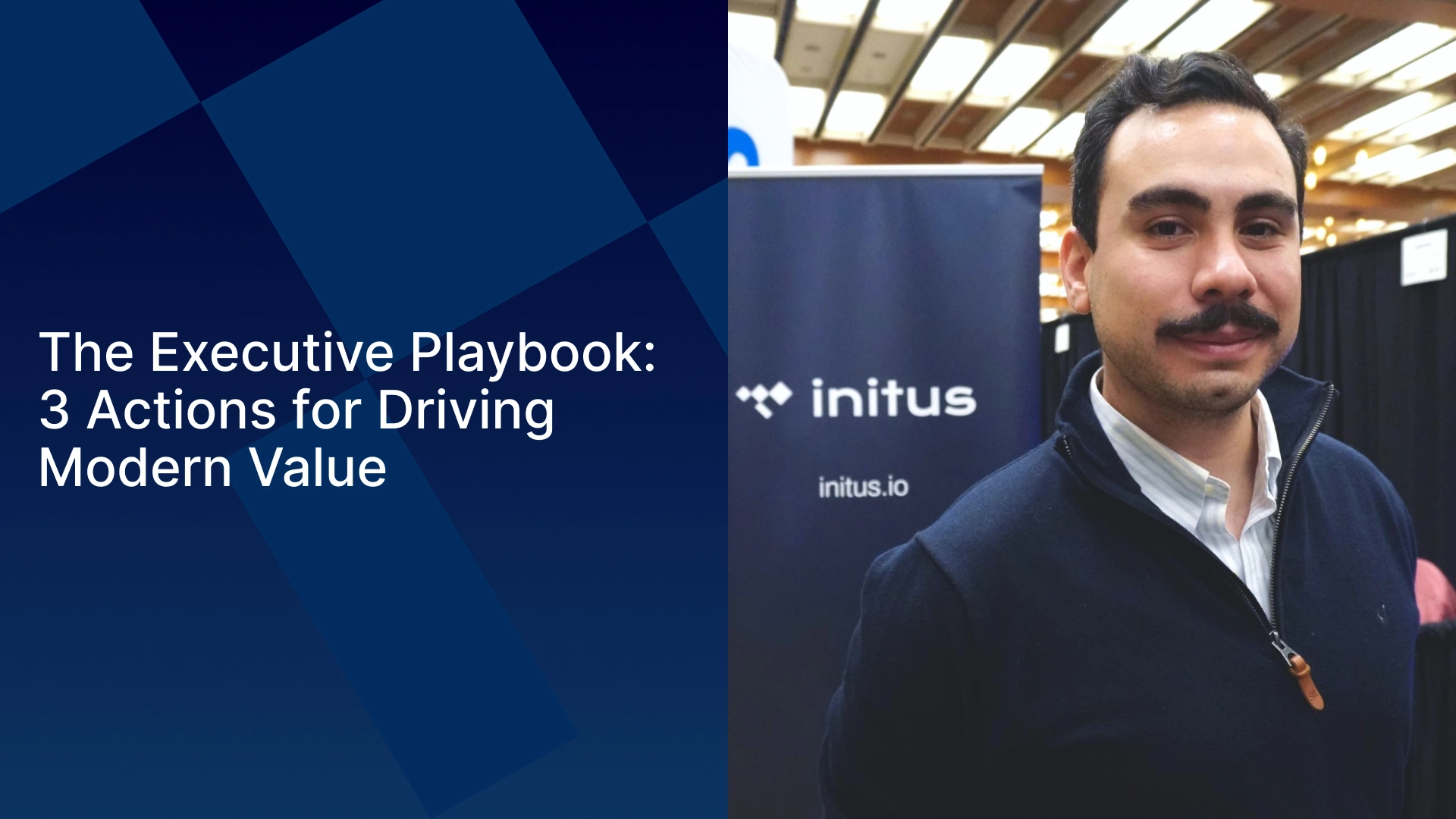
Our own Marcelo Roldan, Implementation and Product UI Lead at Initus Technologies, was recently featured in an exclusive interview with CanadianSME Small Business Magazine. Marcelo outlined exactly how forward-thinking leadership teams can leverage intelligent integration, low-code architecture, and secure, embedded AI to transform disconnected operational tools into a single, high-performance engine.
For CFOs, CIOs, and Operations Leaders focused on margin protection and structural value creation, Marcelo’s framework serves as a strategic blueprint to move past baseline experimentation and start building permanent competitive moats.
Deconstructing the Performance Framework: Legacy vs. Automated Scaling
True organizational transformation requires shifting key operational vectors from legacy, manual processes to intelligent automation. By breaking down this framework into individual components, leadership teams can clearly see the strategic and financial impacts of modernization.
1. Data Integrity: Transitioning from High-Risk Manual Entry to High-Precision IDP
Under a legacy operational model, data moves between systems via manual transcription and double-entry. This approach introduces severe compliance and financial risks, as manual workflows carry error rates as high as 4%. When these errors corrupt financial ledgers or inventory records, the downstream reconciliation costs drain executive time and corporate capital.
Intelligent Process Automation replaces this vulnerability with Intelligent Document Processing (IDP). Platforms like InitusIDP leverage context-aware AI to automatically interpret, validate, and inject structured business data directly into your ERP system. By understanding business context rather than just reading text, this approach elevates data accuracy up to 99%, effectively eliminating downstream transcription risk.
2. Infrastructure Architecture: Eradicating the 10% Integration Gap
Many mid-market organizations manage a fragmented software stack where CRM, accounting, and e-commerce applications operate in total isolation. According to Statistics Canada, only 10% of businesses have fully integrated their digital infrastructure. This extensive “Integration Gap” creates isolated data silos, making real-time reporting impossible and causing corporate performance to hit an operational ceiling.
Modern scaling requires a low-code integration platform like InitusIO to serve as a centralized synchronization layer. This architecture securely maps complex business logic—including custom tax rules and multi-currency conversions—across all enterprise software applications without requiring extensive in-house development teams. The moment an event occurs in one application, the data instantly updates across your inventory, accounting, and shipping workflows, establishing an uncompromised single source of truth.
3. Resource Leverage: Achieving Capacity Liberation Over Linear Headcount Growth
When a business relies on manual workflows, scaling up transaction or order volumes forces a linear expansion of headcount. In a tightening labor market with rising wage pressures, this strategy directly erodes profitability and ties company growth to hiring capacity. Teams spend their entire week acting as human transcribers rather than executing high-margin strategic initiatives.
By implementing automated task routing and fully synchronized workflow ecosystems, organizations unlock what Marcelo calls “capacity liberation”. Instead of hiring multiple team members to manage expanding transaction queues, your existing core team can comfortably handle up to a 10x increase in throughput. This allows corporate operations to remain remarkably lean, ensuring that as top-line revenue climbs, your administrative overhead remains completely flat.
4. AI Deployment Strategy: Shifting from Experimental Leakage to Protected Competitive Moats
While many organizations are actively experimenting with AI, the vast majority simply deploy public, off-the-shelf tools. This introduces an immediate data governance crisis, as companies inadvertently leak proprietary business logic, client data, and intellectual property into public models. This approach fails to build enterprise value, as competitors are leveraging the exact same generic utilities.
True technical maturity requires transitioning to Embedded AI. This means deploying private, ring-fenced Large Language Models (LLMs) inside a secure enterprise infrastructure that interacts directly with your internal data. When AI handles automated product descriptions, fraud detection, or call sentiment analysis within a closed system, it transforms your data into a defensible, proprietary competitive asset that your competitors cannot replicate.
The Executive Playbook: 3 Actions for Driving Modern Value
To successfully evolve your business processes and maintain a global edge despite market volatility, Marcelo laid out a clear three-step playbook for executive teams:
1. Conduct a Process Friction Audit: Map every single manual touchpoint across your order-to-cash, procurement, and fulfillment cycles. Every manual entry point represents a leak in your bottom-line margin. Prioritize remediation strictly by transaction volume and organizational impact.
2. Prioritize Integration Over Acquisition: Halt the acquisition of net-new software tools until your core technology systems are communicating flawlessly in real time. Optimize your existing stack before expanding it.
3. Deploy Human-Centric Automation: Target automation at roughly 80% of your highly routine, repetitive administrative tasks. This structurally liberates your high-performing talent to focus on high-margin strategic work, relationship building, and product innovation.
The productivity gap is a distinct operational hurdle, but for proactive leadership teams, it represents an unprecedented window of opportunity to drastically outpace competitors who remain tethered to manual data workflows.
To read Marcelo Roldan’s complete feature interview, visit the official CanadianSME Small Business Magazine feature here. If you are ready to eliminate the double-entry tax and architect a fully integrated enterprise engine, contact our implementation engineering team today.